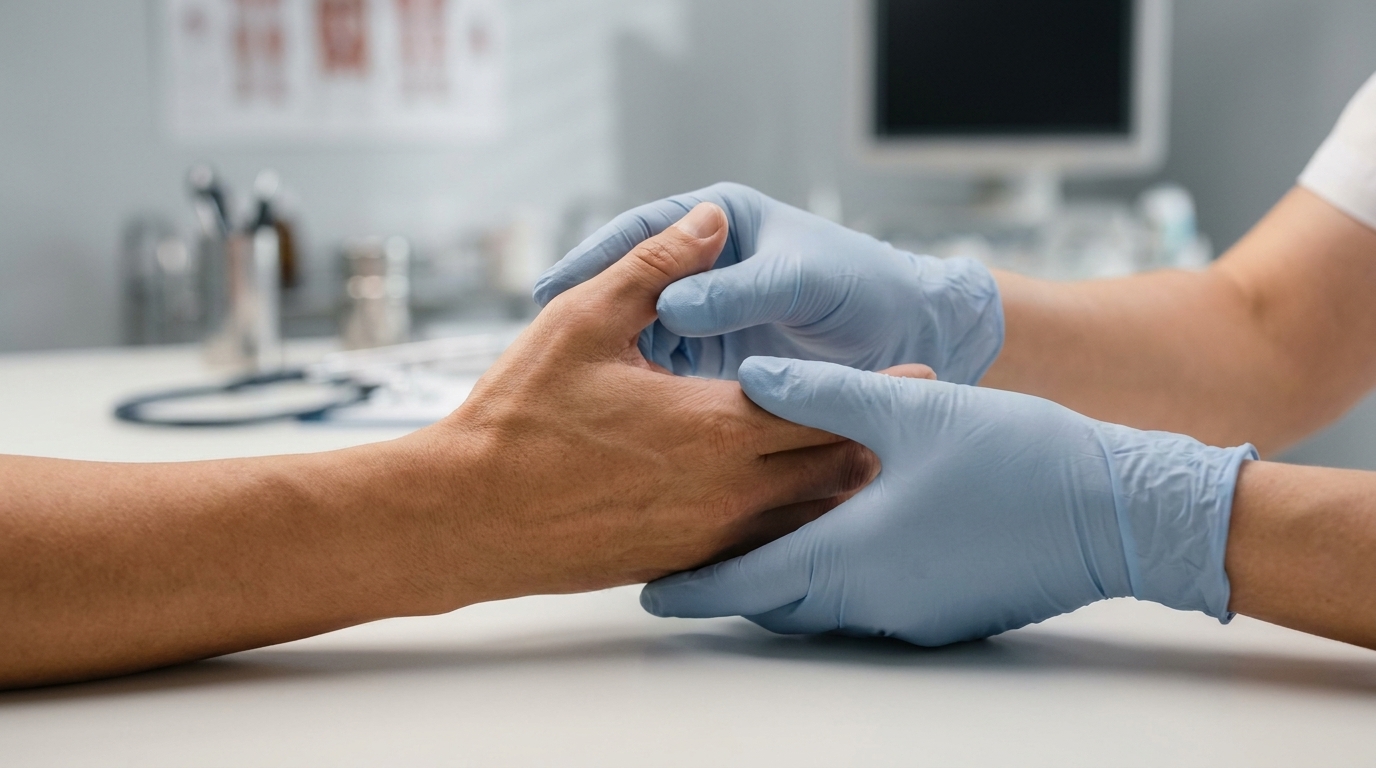
Early hand symptoms like grip weakness and fine motor decline can signal ALS, particularly when painless and progressive in one hand. Recognizing these signs early and seeking specialist evaluation opens access to treatments that work best in initial disease stages.
Understanding Hand Symptoms as Early Warning Signs of ALS
Painless hand weakness that worsens over weeks without numbness is the specific warning sign that warrants immediate neurological evaluation for ALS.
Why hand weakness often appears first in ALS diagnosis
ALS symptoms frequently begin in the hands because the motor neurons controlling fine hand movements have an unusually high representation in the brain's motor cortex, making those nerve pathways more vulnerable to early degeneration. [2] A pattern called [split-hand syndrome](https://alsunited.org/blog/hand-als-symptoms-how-to-detect-motor-decline) — in which the muscles at the base of the thumb and between the thumb and index finger weaken while other hand muscles stay relatively intact — appears in roughly 70% of people with ALS at the time of diagnosis. [2] This occurs because those lateral hand muscles receive stronger direct input from the corticospinal tract, the same neural pathway ALS progressively damages. [2] Mayo Clinic confirms that ALS commonly starts in the hands or arms before spreading to muscles that control swallowing and breathing. [1]
The difference between normal hand fatigue and ALS-related symptoms
Normal hand fatigue resolves with rest and typically comes with soreness or stiffness. ALS-related hand weakness differs in three specific ways: it's painless, it produces no numbness, and it continues worsening over weeks rather than recovering. [3] Neurologists note that gradual hand weakness without pain or numbness is precisely the combination that raises concern for ALS, while weakness accompanied by either pain or numbness points toward other conditions like carpal tunnel syndrome or a pinched nerve. [3] Early ALS symptoms also tend to appear asymmetrically — affecting one hand more than the other — and follow a progressive pattern that doesn't come and go the way ordinary fatigue does. [4]
How early detection through hand symptom awareness changes outcomes
Recognizing hand symptoms early gives people access to treatments and multidisciplinary care that work best at the initial stages of disease. [7] On average, ALS diagnosis takes 10 to 16 months from first symptom, and that delay prevents timely access to approved treatments and enrollment in clinical trials that often require a confirmed diagnosis for eligibility. [5] One meta-analysis found that people diagnosed with ALS more than 12 months prior had a 61% lower mortality risk — a result that reflects how earlier diagnosis aligns with slower disease progression and a broader window for intervention. [5] When a change in grip strength or hand coordination prompts someone to seek evaluation sooner, it shortens that diagnostic gap and expands the decisions available to both the person and their care team. [6]
Specific Early Hand Symptoms to Monitor: A Detailed Essentials
Track whether grip weakness appears first in everyday tasks like holding a cup or turning a key, as these early functional changes often precede clinical strength tests.
Weakness in grip strength and fine motor control (what to notice)
Grip weakness in ALS tends to appear in functional ways before it registers on a clinical strength test. A person may have difficulty holding a cup steadily, turning a key, or gripping a pen — tasks that rely on the small muscles ALS tends to affect earliest. [8] Fine motor control also declines in parallel, making precise movements like fastening buttons or using a zipper harder to complete reliably. [8] These [very early ALS symptoms](https://alsunited.org/blog/very-early-als-symptoms-what-to-look-out-for) tend to start in one hand and worsen progressively over weeks, which is the pattern worth tracking when deciding whether to seek a neurological evaluation. [8]
Muscle twitching, cramping, and fasciculations in hands and forearms
Muscle cramps and fasciculations affect more than half of people with ALS — National ALS Registry data shows muscle cramps in 56.7% of participants and fasciculations in 56.3%, with cramps typically appearing around 12 months before an ALS diagnosis.[10] In the hands and forearms, fasciculations appear as brief, visible ripples or flickers under the skin that occur spontaneously and without pain.[9] Unlike ordinary muscle twitches from fatigue or caffeine, ALS-related fasciculations reflect dying motor neurons losing control of the muscle fibers they once managed, and they tend to become more frequent and spread to adjacent muscle groups over time.[9] When cramping in the hands or forearms appears alongside any degree of weakness — even mild — that combination is worth bringing to a neurologist.[10]
Difficulty with everyday tasks: buttoning, writing, and typing
The first sign of ALS often appears as difficulty with everyday hand tasks — buttoning a shirt, writing, or turning a key — that previously required no effort.[11] These tasks depend on fine motor coordination between small hand muscles and the motor neurons ALS affects earliest, so they tend to decline before strength changes register on a clinical exam.[12] Handwriting may grow inconsistent or cramped, typing becomes slower and less accurate, and fastening buttons can shift from a two-second habit to a frustrating, multi-attempt effort.[11][12] Because these changes are gradual and easy to attribute to tiredness or distraction, many people wait weeks before recognizing the pattern as worth evaluating.[12]
When to Seek Medical Evaluation: Red Flags and Next Steps
Early referral to an ALS specialist and prompt EMG testing can close diagnostic delays that average 3 to 6 months and allow life-extending treatments to start sooner.
How long hand symptoms typically persist before ALS diagnosis
Hand symptoms typically persist for 10 to 16 months before ALS is diagnosed, with some people waiting up to 27 months from first symptom to confirmed diagnosis.[5] The delay most often happens because hand weakness is first attributed to carpal tunnel syndrome, and doctors only begin suspecting ALS once weakness spreads beyond the hand to the forearm or shoulder.[13] Initial evaluation after symptom onset is itself delayed by an average of 3 to 6 months, and roughly 40% of patients reach a non-neurologist before an ALS specialist.[13] Knowing this timeline matters because documenting the pattern of symptom spread and requesting an early referral to a [neurologist who specializes in ALS](https://alsunited.org/blog/what-type-of-doctor-treats-als) are the steps most likely to close that diagnostic gap.[5]
What tests doctors use to confirm or rule out ALS
No single test confirms ALS — the [diagnosis of ALS](https://alsunited.org/blog/symptoms-and-diagnosis) combines clinical findings with tests that rule out conditions with similar presentations. [14] The most critical tool is electromyography (EMG), which pairs nerve conduction studies (NCS) measuring how well nerves transmit electrical signals with a needle EMG that records muscle activity at rest and during contraction. [15] In ALS, needle EMG typically reveals abnormal spontaneous electrical activity in resting muscles — a sign of lower motor neuron damage — and neurologists test muscles across multiple body regions, including areas without obvious weakness. [16] A normal EMG result may point toward a different diagnosis like primary lateral sclerosis, but it does not rule out ALS developing later. [16]
Why early consultation with an ALS specialist matters for treatment options
Seeing an ALS specialist as soon as hand symptoms raise concern matters because the treatments available today work better when started early. Riluzole reduces the risk of death by roughly 20%, and a large clinical cohort found that delaying treatment from 6 to 18 months after symptom onset reduces median survival by approximately 1.9 months — a meaningful difference given the modest gains any current treatment provides. [17] Approved therapies like [Radicava (edaravone)](https://alsunited.org/blog/radicava-a-complete-guide-to-its-purpose-and-value-for-als-patients) also have eligibility criteria that favor earlier-stage disease, and many clinical trials require a confirmed diagnosis to enroll. [17] Requesting a specialist referral when ALS symptoms first appear in the hands — rather than waiting for them to spread — keeps those options open, and we are here for you every step of that process.
Getting Support and Resources From ALS United After Symptom Recognition
Connect with an ALS specialist clinic today to access multidisciplinary teams and social workers who can coordinate your care, mental health support, and practical resources from your first appointment forward.
How ALS United's clinic finder connects you with specialists who recognize early symptoms
Finding an ALS specialist quickly after noticing early hand symptoms is one of the most actionable steps available, and our clinic finder is designed for that purpose. Studies show that attending an ALS clinic on a regular basis can extend life by one year or more, making specialist access a priority worth pursuing as soon as ALS symptoms appear. [18] Our clinic finder connects you with multidisciplinary teams — neurologists, physical therapists, respiratory specialists, and social workers — trained to recognize early ALS symptoms that often go undetected in general neurology settings. [18] You can explore our [care services](https://alsunited.org/blog/our-care-services) to understand what that coordinated support looks like from the first appointment forward.
Accessing medical resources and counseling immediately after symptom awareness
Nearly one in four people with ALS experience depression, with the risk highest immediately before and after diagnosis — making mental health support something to pursue as soon as ALS symptoms surface, not after.[19] Counseling, talk therapy, and medication are established options for managing depression and anxiety alongside physical ALS symptoms.[19] A social worker at an ALS clinic is often the most direct path to those resources: they can coordinate home care referrals, connect you with local and online support groups, and help navigate the decisions that accumulate quickly after symptom onset.[19] Our [ALS support resources](https://alsunited.org/blog/als-support-essential-resources-for-patients-and-families/) bring these services together so you don't have to locate each one separately while managing everything else.
Building your care team: advocacy, support services, and community connection
Building a care team goes beyond clinical appointments — it also includes social workers, peer advocates, and community organizations that provide practical support between medical visits. [19] ALS organizations connect people with care coordinators who can manage home care referrals, link families with financial assistance for ALS-related expenses, and connect you to peer-led support groups where members share coping strategies grounded in lived experience. [20] Advocacy is a dimension many people with ALS find meaningful over time: speaking at educational events, mentoring those recently diagnosed, and engaging healthcare policy are all ways of contributing that also help people process their own diagnosis. [19] You can [become an advocate](https://alsunited.org/blog/become-an-advocate/) to add that layer of connection and purpose to your care journey.
References
- ALS often starts in the hands, feet, arms or legs. Then it spreads to other parts of the body. Muscles get weaker as more nerve cells die. This eventually affects chewing, swallowing, speaking and breathing.
- The 'split-hand' phenomenon is observed in around 70% of patients with ALS at time of diagnosis… The lateral hand groups of muscles (APB/FDI) exhibit a greater anatomical and functional cortical representation, in part related to evolution of specialised activity of these muscles. Consequently, the corticomotoneuronal projections could lead to a greater degree of cortical hyperexcitability and thereby predisposition for neurodegeneration of the spinal motor neurons innervating the lateral hand groups of muscles via an anterograde glutamatergic mechanism.
- ALS typically presents with painless, gradually progressive asymmetric motor weakness. If somebody comes and tells me they have pain and weakness, there is no worry about ALS because pain doesn't fit with this disease. Or if somebody comes and tells me that they have weakness, and also numbness on the same location, I'm happy because ALS doesn't cause numbness. But if someone comes and tells me they have weakness in their hand that's been gradually going on for some time and there is no pain or numbness, I get worried.
- ALS is a progressive disorder, meaning symptoms continually get worse as time goes on. Patients may experience some day-to-day variability in their experiences of symptoms, and there may even be times when some lost functionality is recovered, but such periods are almost always temporary and patients will eventually experience continued symptom worsening.
- Early ALS diagnosis and referral to a multidisciplinary specialized center are vital to improve outcomes. An analysis of 21 retrospective studies found that the median interval from symptom onset to diagnosis for patients with ALS was between 9.1 and 27 months. On average, diagnosis took 10 to 16 months. A meta-analysis found that people who had been diagnosed with ALS more than 12 months prior had a 61% lower mortality risk.
- Delayed diagnosis is a problem, because it prevents individuals with ALS from seeking multidisciplinary care that may improve their quality of life and defers the initiation of disease-modifying treatment. Delayed diagnosis of ALS not only defers access to approved treatments, but it also prevents timely enrollment in clinical trials, which often require a clinical definition of definitive or probable diagnosis of ALS for eligibility.
- Because the limited therapeutic options available are more effective at the initial stages of the disease, an early diagnosis is crucial for longer survival rates.
- You might find yourself having trouble with tasks that require fine motor skills, like writing, turning a key, or fastening a button.
- Muscle twitches are brief, sporadic, and typically localized to specific muscle groups. While they may be visible or palpable, they are generally not painful but can become more persistent and widespread over time as the disease progresses.
- The most frequent symptoms included muscle cramps (56.7%), fasciculations (56.3%)… The median time between an increase of muscle cramps until an ALS diagnosis was 12 months.
- The first sign of ALS usually appears in the hand or arm and can show as difficulty with simple tasks such as buttoning a shirt, writing, or turning a key in a lock.
- Writing may become messy, turning a key in a lock can be difficult, or you might find yourself fumbling with a zipper. It could be a new clumsiness in your hand that makes buttoning a shirt frustrating, which you chalk up to being tired.
- Initial delay to first evaluation (usually by a primary care provider) averages 3-6 months. About 60% of patients are then referred to neurologists while the remaining 40% are referred to non-neurologists.
- ALS can be hard to diagnose, especially in early stages, because symptoms can be similar to other diseases. Tests to rule out other conditions or help diagnose ALS might include…
- An EMG involves a series of tests, including both nerve conduction studies (NCS) and needle electromyography (needle EMG), that measure your nerve signaling and muscle response. Specifically, NCS measures how well your nerves can send signals to your muscles and the needle EMG measures the electrical activity of your muscles.
- A common abnormal result in ALS patients is spontaneous electrical activity when the muscle is at rest. A normal EMG result will often result in a diagnosis of primary lateral sclerosis (PLS), but does not rule out the possibility of ALS developing later.
- Delaying riluzole initiation by 1 y (6 to 18 months from onset) may translate to reducing median survival from onset by 1.9 months (40.1 to 38.2 months). Early diagnosis of ALS will facilitate early treatment and is expected to improve survival. By IPTW, estimated riluzole hazard ratio was 0.798.
- Once you feel that your ALS diagnosis is accurate, schedule an appointment at an ALS clinic in your area. In addition to improving quality of life, studies have shown that attending an ALS clinic on a regular basis can extend your life by one year or more.
- almost one-quarter of people living with ALS experience depression, and the risk is often highest immediately before a person is diagnosed and soon afterward. Both anxiety and depression can be treated in a variety of ways depending on the person's situation and specific condition. Treatment strategies may include counseling or talk therapy, medications, and talking with others in a support group. A good place to start is with a social worker at an ALS clinic or ALS organization, who can provide connections to local support groups, referrals to home care and respite services.
- You will be partnered with a Care Services Coordinator who will work with you to determine your current and future needs… ALS Financial Assistance Program: People living with ALS can apply for financial assistance for ALS-related expenses such as respite care, counseling, co-pays for healthcare costs, home modifications, and more. In-person and virtual support groups for people living with ALS, family members, and friends.