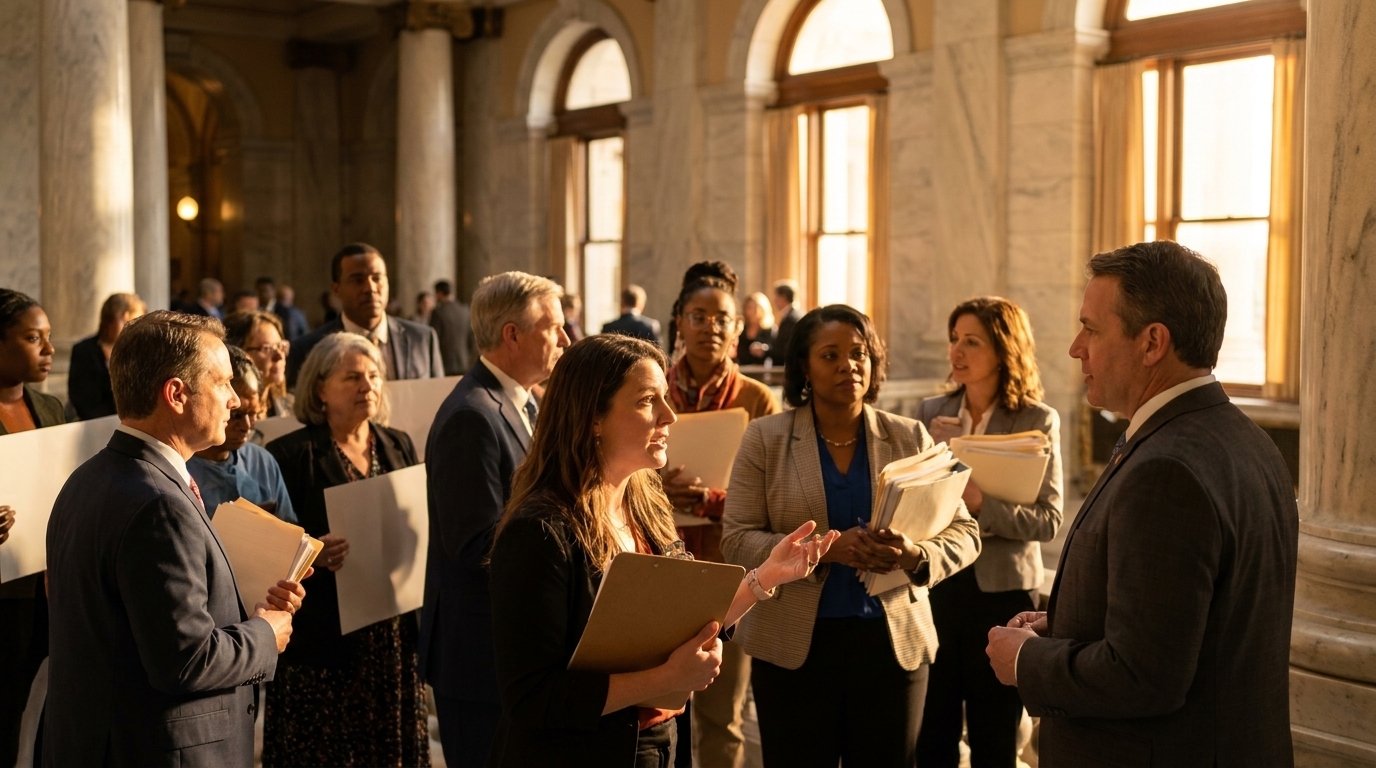
Learn how to effectively advocate for ALS policy change by contacting lawmakers, sharing personal stories, and joining community efforts that directly influence federal funding and care access. Your individual voice, combined with thousands of others, has already secured $1.6 billion in research funding and expanded treatment access for people living with ALS.
What Is an ALS Advocate and Why Your Voice Matters
Your individual voice, joined with thousands of others, drives measurable policy wins that expand research funding and care access for people living with ALS.
Defining ALS advocacy: Beyond awareness to systemic change
ALS advocacy goes beyond raising awareness — it means actively working to change the laws, policies, and funding systems that affect people living with ALS and their families. [1] An ALS advocate is someone who uses their voice to educate lawmakers, push for legislative priorities, and hold government accountable for expanding research, improving care access, and strengthening financial support. [2] This work spans federal, state, and local levels, mobilizing patients, caregivers, and community members to take direct action that shapes real policy outcomes. [3] Decades of organized engagement, documented in our [advocacy history](https://www.alsunited.org/advocacy-history), show how individual voices — when united — have delivered measurable wins, from increased federal research funding to expanded care coverage for people living with ALS.
How individual advocates shape policy and funding for ALS research
Individual advocates drive measurable policy results. In the first six months of 2023, ALS advocates sent more than 30,000 letters to Washington and took over 40,000 collective actions, while state-level funding allocations grew from roughly $6 million to $20 million in a single year.[4] Sustained grassroots pressure from patients, caregivers, and community members was central to passing the ACT for ALS Act in December 2021, which expanded access to investigational treatments and eliminated Medicare waiting periods for people living with ALS.[5] Personal stories from advocates also directly shape federal messaging — collected, anonymized, and submitted to agencies like CMS to document access gaps and push for coverage changes.[4]
The ripple effect: Why one person's advocacy helps thousands living with ALS
When a single advocate sends a letter, attends a town hall, or submits a personal story, that action joins a larger record that lawmakers and agencies draw on when making funding and coverage decisions. Through sustained collective effort since 2019, advocacy has contributed to more than $1.6 billion in secured federal ALS research funding — resources that flow to researchers, clinicians, and patients who never made a single call to Congress. [6] Victories like Medicare coverage for complex rehab equipment and Social Security disability recognition for people with ALS now protect thousands of families who benefit from policy changes they never knew were fought for. [2] Together in the fight, every advocate's voice extends further than they can see.
Concrete Ways to Advocate for the ALS Community Right Now
Contact elected officials with personal stories and focused talking points to shape ALS legislation and funding priorities in your community.
Contact elected officials: Template letters and talking points for ALS legislation
Contacting your elected officials is one of the most direct actions you can take for ALS legislation. A single-page letter or email works best when it opens by identifying you as a constituent and naming the specific bill you support or oppose, using its official House or Senate bill number. [7] Choose three focused talking points — such as research funding gaps, care access barriers, or coverage delays — and tie at least one to a personal story that shows how ALS affects your family or community. [7] Legislative offices track constituent messages and use them to gauge local support when forming positions, so every letter adds to the public record. [8] Our [action alerts page](https://www.alsunited.org/advocacy-action-alerts) keeps current bill numbers and ready-to-send templates updated throughout each legislative session.
Participate in ALS United's community advocacy programs and local events
Community-led advocacy events do more than raise awareness — they place the community's voice directly in front of the state and local leaders who set funding priorities and shape program access. [9] These events create documented opportunities to reduce stigma, highlight service gaps, and give policymakers firsthand exposure to the people their decisions affect. [9] Community advocacy is, at its core, a strategic approach to representing your community's needs to the level of government best able to respond — and local events are where that representation becomes real and visible. [10] Our member events and local advocacy programs are built around this model, connecting people living with ALS and their caregivers with others who share the same fight and the same goals. You can find current events and ways to participate at [alsunited.org](https://www.alsunited.org/).
Share your story: How personal narratives drive policy change and funding decisions
Personal stories move lawmakers in ways that statistics alone cannot — a reality Jen Psaki, who worked closely with ALS advocates during the Biden administration, described plainly: Washington officials are "motivated less by data and statistics and more by human stories." [11] When Brian Wallach and Sandra Abrevaya testified before the House Committee on Energy and Commerce's Subcommittee on Health in July 2021, Wallach opened with a single line: "This is our closing argument for our lives" — testimony that helped build the bipartisan momentum behind the ACT for ALS Act. [12] Sharing your story through written testimony, congressional visits, or organized advocacy campaigns places it in the official record, where it directly shapes funding priorities and coverage decisions for thousands of people living with ALS. [11]
ALS Advocacy Wins: What Advocates Have Already Achieved
Sustained advocacy has secured $315 million in federal ALS research funding for FY2026–the highest level ever–while pressing Congress to reauthorize the ACT for ALS and pass critical caregiver support legislation.
Federal legislation timeline: Key ALS victories from 2020 to 2026
The ACT for ALS, passed in December 2021 with bipartisan support, established five years of federal funding for [expanded access to investigational treatments](https://www.alsunited.org/act-for-als) and a coordinated national research infrastructure that did not previously exist. [13] The FY2026 federal funding package, secured through sustained advocate engagement, delivered $45 million in new research increases — including $90 million for ACT for ALS programs at NIH and a new $30 million investment through ARPA-H. [14] With the law set to expire in September 2026, advocates are now pressing Congress to reauthorize it without delay, as lapsing would put $500 million in future funding and the expanded access program at immediate risk. [13]
Access to care improvements won through sustained advocacy efforts
Sustained advocacy has produced concrete improvements in healthcare access and financial support for ALS families. The Credit for Caring Act (H.R. 2036/S.925) would give working family caregivers a federal tax credit of up to $5,000 — recognition that unpaid caregiving carries real financial costs for families already managing significant medical expenses. [15] The Justice for ALS Veterans Act (H.R. 749/1685) targets a documented gap in VA survivor benefits: veterans are twice as likely to be diagnosed with ALS as the general population, yet many surviving families are excluded from full compensation because ALS typically progresses faster than the eight-year threshold current policy requires. [15] Advocates continue pressing for the ALS Better Care Act to address additional coverage barriers that affect day-to-day care access for people living with ALS. [15]
Research funding increases: How advocacy translates to clinical breakthroughs
Federal ALS research funding for FY2026 reached $315 million — the highest level ever secured — driven by a coalition of more than 30 ALS organizations working alongside individual advocates across the country. [16] This funding directly supports research into the causes of ALS, translation of laboratory discoveries into new treatments, and improvements in clinical trial design and access. [16] Sustained investment through NIH and the Congressionally Directed Medical Research Program (CDMRP) has kept critical research programs running year over year, building the scientific infrastructure needed to move potential treatments from the lab toward patients. [2] As ALS advocates and organizations noted after the vote passed, every phone call, meeting, and letter to congressional leaders truly mattered — a direct line between grassroots advocacy and clinical progress. [16]
Getting Started With ALS United's Advocacy Network
ALS United's structured advocacy training and peer support networks empower new advocates to act locally with confidence, regardless of prior policy experience.
Find your local advocacy chapter: ALS United's clinic finder and member organizations
Finding your nearest ALS United member organization starts with the clinic finder at alsunited.org, which maps regional member organizations that coordinate local advocacy, events, and care access. As of September 2023, fifteen independent chapters — representing nearly half of the U.S. ALS patient community and more than half of all Certified Treatment Centers of Excellence and multidisciplinary specialty clinics — operate as a coordinated network, each focused on the distinct needs of its region while sharing information and resources across the country. [17] Local member organizations connect people living with ALS and their families to care services, advocacy opportunities, and community events, while the national network ties their work to federal legislative priorities. [18] These organizations make it possible to act locally with national impact.
Training and resources: What ALS United provides to new advocates
New advocates entering the ALS network don't need prior policy experience to get started — structured training resources exist to build confidence from the ground up. Effective advocacy training combines self-paced learning modules, expert-led webinars, and downloadable toolkits that participants can work through on their own schedule. [19] Programs built for people with real workloads focus on actionable steps rather than theory — skills like contacting legislators, sharing personal testimony, and engaging in coalition campaigns. [20] Our resources follow this model, giving every new advocate a clear foundation to act with confidence at any level of the legislative process.
Connect with others: Community events and support networks for advocates and caregivers
Community events and peer support networks give ALS advocates and caregivers both emotional grounding and practical knowledge that sustains long-term engagement. Peer support groups with recurring monthly schedules — including virtual care groups organized around specific caregiving situations — make consistent connection accessible regardless of location. [21] Studies show that caregiver support services reduce depression, anxiety, and stress while enabling caregivers to provide care longer — in one year alone, more than 700,000 caregivers received services through the National Family Caregiver Support Program. [22] Our [ALS support groups](https://alsunited.org/blog/als-support-groups-connecting-with-others-facing-the-disease/) connect people living with ALS, caregivers, and advocates with others who share the same experiences — with community that lasts beyond any single event.
References
- Our advocacy work focuses on educating and mobilizing members of Congress and the Administration in a nonpartisan way to achieve our mission of driving the discovery of prevention strategies, treatments, and cures for ALS; providing access to quality care and connection; and promoting initiatives to improve health outcomes.
- As an ALS Northwest advocate, you can help change the laws and policies that affect thousands of persons with ALS and their families.
- ALS Arizona advocates to educate and mobilize lawmakers and government leaders in support of people living with ALS and their families, while advancing research toward effective treatments and an end to ALS.
- They have sent over 30,000 letters to Washington in the first six months of 2023… they were able to increase around $20 million in just their first year… over 40,000 actions taken through their action center… they collected stories, removed personal information, and sent them directly to the insurance companies… used Quorum Sheets to collate comments from advocates that they later sent to CMS
- The ACT for ALS Act (December 2021) eliminates waiting periods for Social Security Disability Insurance and Medicare benefits for ALS patients, expands access to assistive technologies, and supports home healthcare services. The advocacy campaign combined economic analysis, celebrity endorsements, and congressional testimony to secure bipartisan support.
- Since its founding in 2019, I AM ALS has helped transform the federal ALS funding landscape: elevating patient voices, building bipartisan champions, and pushing for bold investments that break down silos and speed progress. Our relentless advocacy has directly contributed to the more than $1.6 billion now secured for federal ALS research dollars
- If your letters pertains to a specific piece of legislation, it helps to identify it by its bill number (e.g. H.R. ____ or S. _____). State Who You Are and What You Want Up Front: In the first paragraph, tell your legislators that you are a constituent and identify the issue about which you are writing.
- A handwritten letter has more weight than a typed letter, which has more weight than an email. The longer it takes you to write the letter, the more value it has to your representative.
- Many of these organizations host statewide and local community-led events in their advocacy work. These events highlight behavioral health services for underserved populations, provide opportunities to reduce stigma, and inform state and local leaders about the needs of underserved populations.
- Community advocacy is a strategic approach to influencing outcomes and driving change on behalf of your community. It involves representing your community's rights and needs to the level of government best able to respond.
- People here in Washington … are motivated to do good, and do better. They're motivated less by data and statistics and more by human stories. The willingness to put your story out there, to testify, to go see members [of Congress], but also to make direct asks — I don't think you know how to do that unless you've worked around this town.
- On July 29, 2021, Wallach and Abrevaya gave testimony at a congressional hearing with the House Committee on Energy and Commerce's Subcommittee on Health. 'This is our closing argument for our lives,' Wallach said in his introduction.
- We are five years into ACT for ALS and it must be reauthorized by Congress by September 2026 or we stand to lose $500 million, the expanded access program, and the vital research infrastructure it supports.
- The FY26 funding package includes $45 million in new increases for ALS research and related programs. This includes $90 million for ACT for ALS at National Institutes of Health (NIH) and a new $30 million investment for ALS research through ARPA-H.
- The Credit for Caring Act 2025 (H.R. 2036/S.925) would provide a new federal tax credit of up to $5,000 for working family caregivers. Veterans are twice as likely to be diagnosed with ALS as the general population, regardless of branch of service. Under current VA policy, families only receive enhanced Dependency and Indemnity Compensation if the veteran lived with a fully debilitating condition for at least eight years. Since ALS progresses rapidly–often within 2 to 5 years–many families are unfairly excluded.
- On Feb. 3, 2026, the U.S. Congress approved new federal funding for ALS research for Fiscal Year 2026, totaling $315 million, the highest level of funding ever for ALS research… Every phone call, meeting, and letter to congressional leaders truly mattered… This funding will advance research to better understand ALS, translate discoveries into new treatments, improve clinical trials, and strengthen collaboration across the research community.
- These chapters represent nearly half of the patient community and more than half of the Certified Treatment Centers of Excellence and multidisciplinary specialty clinics for ALS in the United States. The 15 chapters are collaborating closely and will continue to maintain a robust network of information and resource sharing across the ALS community. Each one of the 15 chapters…is an independent organization that is well-positioned to continue effectively meeting the unique needs and responding to key priorities of the local communities that it serves.
- The Chapter focuses primarily on helping local patients and families live with ALS while the National Office focuses primarily on research and advocacy. The National Office supports the Chapters by providing up-to-date information and materials.
- The Advocate Institute houses all of our self-paced courses, downloadable guides, webinars, and custom programs for individuals and groups.
- For people with full workloads and real-world responsibilities, this virtual webinar cuts through jargon and theory to focus on clear, actionable steps you can take to influence change.
- Care Group: Caring for Someone Sixty and Under — Every 2nd Tuesday of the month; Care Group: Caring for Someone Over Sixty — Every 3rd Tuesday of the month; Care Group: Those Experiencing Divorce or Separation from their Care Recipient — Every 4th Tuesday of the month
- Studies have shown that these services can reduce caregiver depression, anxiety, and stress as well as enable caregivers to provide care longer, thereby avoiding or delaying the need for costly institutional care. In FY 2014, the most recent year for which service data is available, more than 700,000 caregivers received services through the NFCSP.