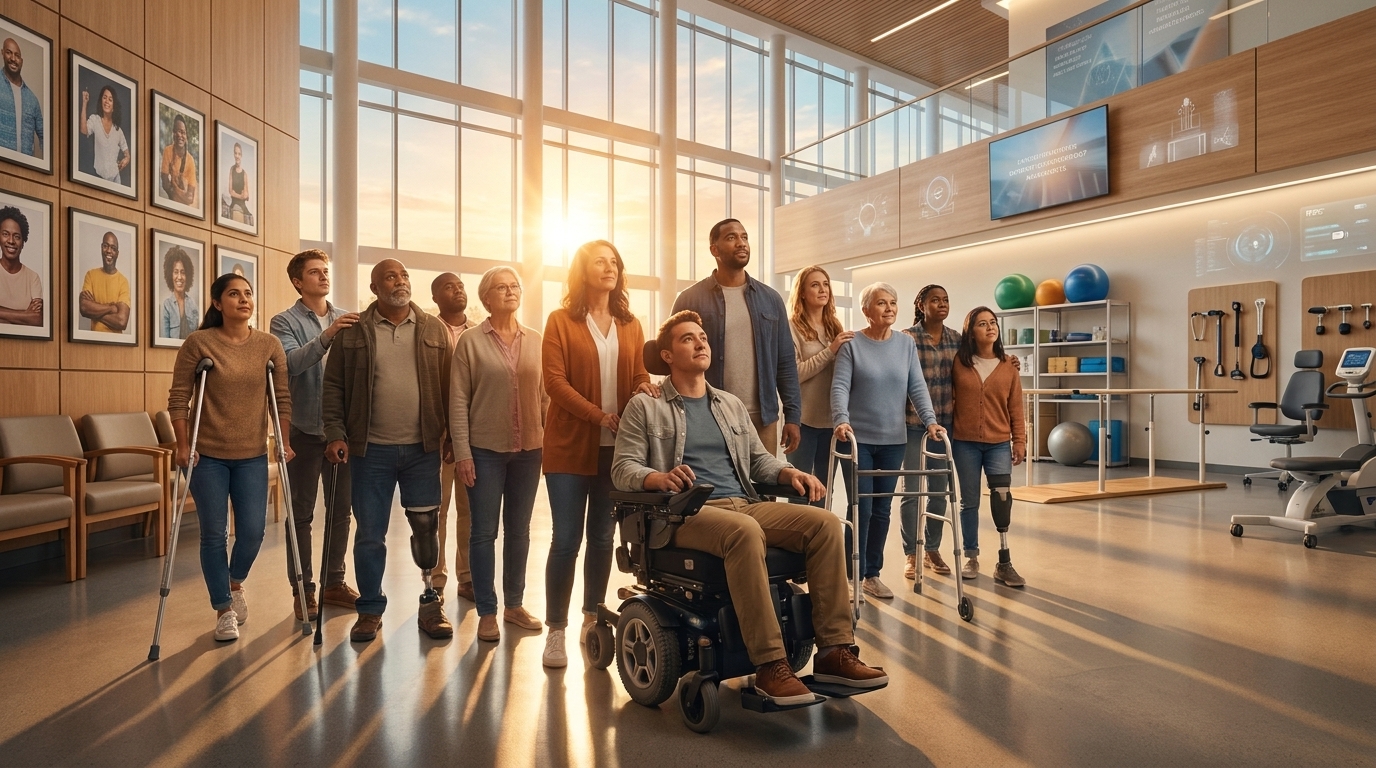
Learn how people living with ALS have found meaning and resilience while navigating this disease, and discover the comprehensive care and community support that directly shapes their quality of life. Their stories reveal that early symptom recognition, multidisciplinary medical teams, and emotional support create pathways to longer survival and greater independence.
Who Has ALS? Notable Individuals Living with the Diagnosis
People living with ALS who receive comprehensive care and medical support experience significantly better long-term quality of life and outcomes.
Stephen Hawking: The Physicist Who Changed Our Understanding of the Universe
Stephen Hawking was diagnosed with ALS at 21 and lived with the disease for 55 years, dying in March 2018 at age 76 — far beyond the two-to-five-year survival window most people with ALS face after diagnosis. [1] His form of the disease progressed slowly and left his cognitive function entirely intact, allowing him to spend 30 years as a mathematics professor at the University of Cambridge and write A Brief History of Time. [2] After a 1985 bout of pneumonia required a tracheostomy that permanently removed his voice, he communicated through a computer speech synthesizer he controlled with his cheek. [3] Neurologists attribute his longevity to both the unusual biology of his slowly progressive form of ALS and the round-the-clock medical and nursing care he received — a combination that, for most people living with the disease today, underscores how directly access to [comprehensive care](https://alsunited.org/blog/our-care-services) shapes long-term quality of life. [1]
Eric Dane: Breaking Silence in Hollywood About ALS
Eric Dane, known for his roles in Grey's Anatomy and Euphoria, announced his ALS diagnosis in April 2025 and died ten months later at age 53. [4] His first symptom was weakness in his right hand — something he dismissed as texting fatigue until it worsened over several weeks and led him through two hand specialists and two neurologists before a diagnosis was confirmed. [5] Dane joined the board of a nonprofit ALS research organization and used his platform to advocate for research funding, saying he hoped to change "what it means to get an ALS diagnosis" so that "this community deserves effective treatments." [5] His account of how an easy-to-overlook symptom progressed to a confirmed diagnosis has given others a concrete reference point for recognizing early signs and seeking evaluation sooner. [5]
Rebecca Luker, Kim Shattuck, and Other Performers Advocating for ALS Awareness
Several performers across theater and rock music have used their diagnoses to bring ALS into public conversation. Broadway soprano Rebecca Luker — a three-time Tony nominee for Show Boat, The Music Man, and Mary Poppins — announced her ALS diagnosis in February 2020 and died 10 months later at 59, with a posthumous duet appearing on Broadway actor Aaron Lazar's Grammy-nominated album Impossible Dream, which raised funds for ALS research and awareness. [6] Kim Shattuck, lead guitarist for The Muffs and a former Pixies bassist, died in October 2019 after a two-year struggle with ALS in her 50s. [6] Singer-songwriter Roberta Flack was diagnosed in 2022 and died at 88 in February 2025, while Zac Brown Band bassist John Driskell Hopkins, also diagnosed in 2022, was still performing at live events as of early 2025. [6]
What These Stories Teach Us: Common ALS Experiences Across Different Lives
Early ALS symptoms are often misdiagnosed, but recognizing them quickly connects patients to specialist care and opens pathways to treatment.
Early Symptoms That Prompted Diagnosis: What These Individuals First Noticed
Across public accounts from people living with ALS, early symptoms are almost always mistaken for something else. Actor Russell Andrews described dropping cups, frequent twitching, and a sensation of something running up and down his arm at night — all dismissed initially as a pinched nerve; his fiancée noticed he was walking differently and taking longer to complete physical tasks before a diagnosis was confirmed. [7] Jenny Slatten, of 90 Day Fiancé, experienced symptoms for over a year and believed she had a stroke before ALS was identified. [7] These patterns — unexplained muscle twitches, grip weakness, and subtle coordination changes — are consistently the first signs that prompt people to seek evaluation, which is why recognizing [very early ALS symptoms](https://alsunited.org/blog/very-early-als-symptoms-what-to-look-out-for) can shorten the path to specialist care.
How People with ALS Continue Working and Creating Despite Physical Challenges
Aaron Lazar, a Broadway actor living with ALS, produced the album *Impossible Dream* — featuring over 50 performers including Josh Groban, Lin-Manuel Miranda, and Sting — and served as a keynote speaker at BIO addressing more than 10,000 attendees. [8] He found that the physical slowdown ALS creates opened unexpected space: "ALS takes away your physical distractions… I'm going to practice creating for myself health, mentally, emotionally, and spiritually — still be creative, still be present." [8] Theatremaker Erin Merritt, spotlighted within the ALS community, founded Woman's Will and directed 13 productions over 12 seasons with San Francisco's all-female Shakespeare company. [9] Dr. Richard Bedlack, director of the Duke ALS Clinic, observed that patients like Lazar "may be getting weaker on the outside, but the more important stuff on the inside is as good or better than it's ever been." [8]
The Role of Family, Community, and Professional Support in Daily Living
Quality of life with ALS depends as much on the people surrounding a patient as on clinical treatment alone. Gregory Martinez, an ALS patient at UC San Diego Health, described former colleagues building a wheelchair ramp at his home, a friend fundraising for an accessible van, and community donations covering a bathroom remodel — gestures that, he said, "reminded me of people's humanity." [11] The Family Caregiver Alliance confirms that a coordinated team of physicians, physical therapists, occupational therapists, speech therapists, and social workers — alongside a trusted personal caregiver — directly determines how much independence someone with ALS can maintain. [10] [Caregiver and family support resources](https://alsunited.org/blog/for-caregivers-families) can help families build that team before it's urgently needed.
Life Expectancy and Long-Term Outlook: What These Individuals' Journeys Reveal
Recent breakthroughs in drug approval, clinical trials, and brain-computer interfaces offer new hope for slowing disease progression and improving quality of life.
How Diagnosis Timelines Vary: From Stephen Hawking's 50+ Year Journey to Others' Different Trajectories
ALS life expectancy varies widely — the average after diagnosis is 2-5 years, but 10-20% of people live 10 years or longer. [12] Age at onset matters significantly: people who develop symptoms before 65 have a median survival of about 40 months, compared to roughly 26 months for those diagnosed after 65. [12] Bulbar-onset ALS, which first affects speech and swallowing, typically carries an estimated survival under two years from diagnosis — a stark contrast to the limb-onset forms that often progress more gradually. [12] Hawking's case represents fewer than a few percent of all patients, a slowly progressive variant that neurologists attribute primarily to the biology of his particular form of the disease rather than lifestyle factors, underscoring why no two ALS trajectories look the same. [12]
Advances in Medical Care That Have Extended Quality of Life Since Earlier Diagnoses
The FDA approved tofersen (Qalsody) in 2023 for SOD1-variant ALS, and long-term data show roughly one-quarter of participants experienced stabilization or functional improvement over three to five years — outcomes previously unheard of in this disease. [13] The HEALEY ALS Platform Trial, operating across more than 70 U.S. sites since 2020, has enrolled over 1,300 participants and moved two drugs into advanced testing phases. [14] A brain-computer interface trial at Massachusetts General helped a patient with ALS communicate again by decoding brain signals into a synthesized version of his own voice. [14] Stem cell research has confirmed that GDNF-producing neural progenitor cells survive in the spinal cord up to three and a half years post-implant, supporting the progression toward efficacy trials now underway. [15]
Finding Hope Within Realistic Expectations: What Advocates Want You to Know
Dr. Richard Bedlack, director of the Duke ALS Clinic, describes hope as a clinical tool: across multiple terminal diagnoses, patients who remain hopeful show better quality of life, lower symptom burden, and longer survival. [8] He pairs that hope with practical planning — naming what the disease will take while helping patients make care decisions before urgency forces them. [8] Aaron Lazar, who lives with ALS, described the balance plainly: "I want to enjoy every moment of my life, ALS or no ALS." [8] Across patient accounts from people navigating [ALS support resources](https://alsunited.org/blog/als-support-essential-resources-for-patients-and-families/), this combination of clear-eyed acknowledgment and purposeful living consistently defines what resilience looks like in practice. [16]
How to Access the Same Level of Support These Advocates Received
Multidisciplinary clinics reduce one-year mortality by up to 30%, yet only 40% of people with ALS access this coordinated care due to distance and delays.
ALS United's Clinic Finder: Connecting You with Specialized Medical Care
Multidisciplinary ALS clinics bring neurologists, respiratory specialists, physical and occupational therapists, speech pathologists, and social workers together at one location — and research confirms this model reduces one-year mortality by up to 30% compared to general neurology care alone. [17] Despite that evidence, only about 40% of people with ALS in the United States currently access this level of coordinated care, partly because nearly 45% live more than 50 miles from a specialized clinic — and the average time from symptom onset to a first multidisciplinary appointment is 19 months, a gap that directly shapes outcomes. [18] Our Clinic Finder is built to close that gap: search by location to connect with accredited ALS multidisciplinary centers near you, and if distance is a barrier, ask each clinic about telehealth options that many now offer for [ongoing specialist follow-up](https://alsunited.org/blog/what-type-of-doctor-treats-als) without requiring travel. [17]
Emotional Counseling and Support Groups: Building Your Personal Care Team
Emotional support is a documented clinical need, not a supplementary option — unaddressed depression, emotional lability, and isolation are recognized conditions that directly affect quality of life in ALS. [20] Practical pathways include 1:1 counseling with ALS-informed therapists, short-term financial assistance for those without coverage, and facilitated peer connection groups run by professional care managers where patients and caregivers can exchange strategies for preserving independence. [19] Mindfulness tools — including free guided meditation sessions available in multiple languages and lasting between 3 and 13 minutes — provide accessible self-directed support between clinical appointments. [19] [ALS support groups](https://alsunited.org/blog/als-support-groups-connecting-with-others-facing-the-disease/) give patients and families structured space to share what is actually working day to day, covering ground that clinic visits rarely have time to reach. [19]
Advocacy and Community Resources: You Don't Have to Navigate ALS Alone
Advocacy programs give people with ALS and their families a direct path to influencing the funding and policy decisions that shape treatment access. Our [ACT for ALS](https://www.alsunited.org/act-for-als) program connects individuals to federal advocacy efforts and action alerts that translate community experience into policy change. Peer connection groups, facilitated by professional Care Managers, are free and open to people with ALS, caregivers, family members, and friends regardless of location — with topic-specific options designed to fit different stages of the disease. [21] Virtual groups run through Zoom allow participants to join by phone, computer, or tablet, making community connection accessible even when mobility or distance is a barrier. [22]
References
- Stephen Hawking, who died Wednesday at the age of 76, had lived with the crippling disease ALS for 55 years. Survival really depends on the type of medical and nursing care that they get.
- Hawking spent 30 years as a full professor of mathematics at the University of Cambridge.
- I caught pneumonia in 1985. I had to have a tracheostomy operation. The tracheostomy operation removed my ability to speak altogether.
- Dane died Thursday, Feb. 19, the actor's family confirms to PEOPLE… Dane became a star with his role as Dr. Mark Sloan — a.k.a. McSteamy — in Grey's Anatomy. Dane's death comes 10 months after he went public with his diagnosis of amyotrophic lateral sclerosis (ALS)
- He told Good Morning America that his first clue was weakness in his right hand. 'I didn't really think anything of it at the time. I thought maybe I'd been texting too much or my hand was fatigued'… Dane ultimately saw two neurologists before finally receiving an ALS diagnosis… he became a member of the Target ALS Board of Directors… '[changing] what it means to get an ALS diagnosis. This community deserves effective treatments, and I want to do my part to deliver them.'
- Rebecca Luker made her Broadway debut in 1988… She was first nominated for a Tony in 1995 for her role as Magnolia in Show Boat and was later nominated for her leading role in The Music Man in 2000, and again in 2007 for Mary Poppins. In February 2020, Luker revealed that she had been diagnosed with ALS… Just 10 months after sharing the news, Luker died. She was 59. Kim Shattuck, lead guitarist for the punk rock band The Muffs and onetime bassist for the Pixies, was diagnosed with ALS in her 50s. In October 2019, her husband Kevin Sutherland shared that she had died 'after a two-year struggle' with the illness. In 2022, it was announced that Roberta Flack had been diagnosed with ALS and that it had become 'impossible' for her to sing… In February 2025, the Grammy-winner died at 88. Founding member and bassist for Zac Brown Band, John Driskell Hopkins, shared his diagnosis in 2022… As of February 2025, Hopkins was still performing — hitting the stage at the 2025 Game Changer Gala in New Orleans.
- Russell Andrews: 'There were moments there were twitches. There were things that I thought I was having pinched nerves in my neck… I was dropping cups and glasses, and in the night, it felt like things were running up and down my arm.' His fiancée Erica Tazel: 'it took him longer to clean the pool. The way he walked, there was a subtle little [change].' Jenny Slatten: 'There was a rumor that I had a stroke, but it turned out to be ALS' after experiencing symptoms for more than a year.
- Aaron Lazar discussing his ALS journey, the Impossible Dream album featuring 50+ performers, his keynote at BIO, and his quote about ALS taking away physical distractions while continuing to create; Dr. Bedlack's observation that patients may be getting weaker outside but the important stuff inside is as good or better.
- Erin Merritt founded Woman's Will, San Francisco's all-female Shakespeare company, in 1998 and directed 13 productions over 12 seasons, spotlighted by the ALS Network as an inspirational theatremaker.
- Family caregivers, physicians, nurses, physical therapists, speech therapists/pathologists, occupational therapists, and social workers all working together with the person with ALS can help ensure a high quality of life and as much independence as possible.
- Former health care colleagues volunteered their time to build a wheelchair ramp at his home. A friend who hosts a podcast rallied listeners to help raise funds toward a down payment on an accessible van. Donations from friends and strangers helped remodel his bathroom so he could shower safely. 'They reminded me of people's humanity,' said Martinez.
- Around 10-20% of people with the condition may live for more than 10 years… participants who were younger than 65 at symptom onset had a median survival time of 40.2 months. Participants older than 65 had a median survival time of 25.9 months… People with this type of ALS have an estimated survival of fewer than 2 years from diagnosis.
- long-term use of tofersen, a new drug approved by the Food and Drug Administration (FDA) for a genetic form of this deadly illness, delays symptom progression and death and in about one-quarter of participants leads to stabilization or improvement
- more than 1,300 people have participated in the platform trial and seven drugs were evaluated… BrainGate researchers tested an implantable brain-computer interface that helped a 45-year-old patient with ALS successfully communicate again
- Postmortem spinal tissue revealed that the stem cells were still alive and producing GDNF in the treated side of the spine for up to three-and-a-half years after transplantation
- Multiple patient accounts describing purposeful living alongside honest acknowledgment of ALS progression, including statements such as 'I have ALS but ALS doesn't have me' and 'I'm not dying of ALS, I am living with it.'
- Care delivered and coordinated by multidisciplinary clinics (MDCs) specializing in ALS has been shown to extend survival and improve the quality of life for patients. Activation of inter-service communication across different care sectors by specialized ALS clinics has proven to be essential for the delivery of high-quality care in ALS.
- Numerous studies have demonstrated that multidisciplinary care decreases 1-year mortality by as much as 30 percent. ALSA estimates that approximately 12,000 people living with ALS receive care at a multidisciplinary clinic every year, representing about 40 percent of the overall U.S. ALS patient population. A spatial analysis of 2013 data from the National ALS Registry found that 44.9 percent of people living with ALS in the United States lived more than 50 miles from a multidisciplinary clinic. The average time from symptom onset to a patient's first appointment at a multidisciplinary clinic in the United States is 19 months.
- We offer short-term financial assistance for counseling, as well as referrals to therapists who know and understand ALS… All ALS Network groups are facilitated by our professional Care Managers, who have extensive experience in ALS… UCLA Mindful Guided Meditations offer free online sessions in 15 languages, each lasting between 3 and 13 minutes.
- Identifying and Treating Depression… Monitoring Cognitive and Behavioral Changes… Understanding Pseudobulbar Affect… Finding Quality of Life
- Connection groups provide opportunities for people living with ALS and their loved ones to share their personal experiences and learn more about strategies for preserving independence and maximizing quality of life. All ALS Network groups are facilitated by our professional Care Managers. Groups are offered free-of-charge and are open to people with ALS, caregivers, family members, and friends.
- These groups reduce feelings of isolation and provide participants the space to talk openly about their experiences and feelings. Groups take place virtually through Zoom, which includes a type-in-chat feature. Participants can join by phone, computer, or tablet with a steady internet connection.